
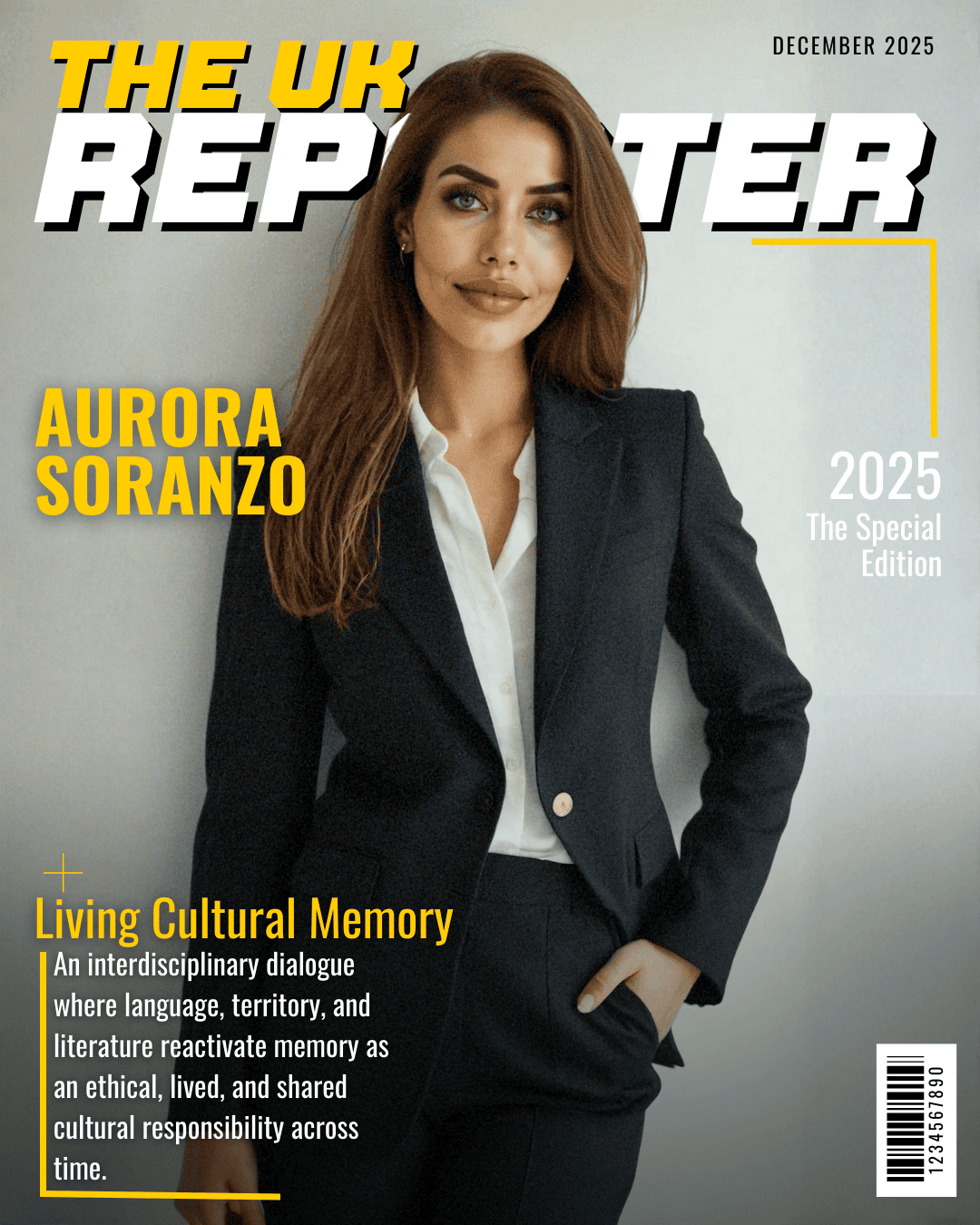
There are cities that do not merely host history, but quietly converse with it. In Padua, among stone façades shaped by centuries and streets where language still carries echoes of the past, the work of Aurora Soranzo finds its natural horizon. Writer, poet, and graphologist, Soranzo embodies a cultural approach in which memory is not preserved as an artifact, but experienced as a living presence—something to be interpreted, transmitted, and renewed.
Aurora Soranzo’s early intellectual horizon was deeply influenced by her father, Dario Soranzo, whose scholarly work and collaboration with the linguist Giovan Battista Pellegrini formed part of internationally recognised linguistic research. Through his example, she developed an understanding of language as a rigorous field of study and as a responsibility toward cultural transmission. His premature death, which occurred in Casalserugo on December 4, 1998, at the age of 49 after an incurable illness, marked a decisive personal and intellectual moment, further reinforcing in her work the awareness that knowledge and memory endure only through conscious care and continuity.


Territory as a Cultural Matrix
With an academic background in history and art history, Aurora Soranzo has developed a research path that places territory at the centre of literary interpretation. Her studies devoted to the Italian years of George Gordon Byron focus particularly on the Veneto, understood not simply as a geographical setting but as a formative cultural environment.
In this perspective, landscapes, dialects, and social contexts become active forces in literary creation. Byron’s presence in Italy emerges as a process of profound interaction with place—an experience that shaped his imagination, language, and worldview. Soranzo’s research invites readers to reconsider the relationship between literature and geography, restoring to places their role as silent custodians of memory.
Literature, Place, and Narrative Responsibility
This approach finds full expression in her volume I luoghi di George Gordon Byron nel Veneto. Il Lord che parlava veneziano. The book stands out for its ability to combine historical precision with narrative clarity, offering a form of cultural storytelling that remains rigorous while accessible.
Rather than isolating Byron within the canon of Romantic literature, Soranzo situates him within lived spaces: villas, streets, waterways, and spoken language. These locations are treated as narrative keys—elements that allow literary history to be reactivated in the present. The result is a work that contributes not only to Byron studies, but also to the broader reflection on how cultural heritage can be read, understood, and shared today.
Writing, Identity, and the Traces of the Self
Beyond academic research, Aurora Soranzo’s literary production explores writing as a tool for investigating identity. Her poetry and prose move between personal introspection and collective memory, suggesting that individual experience is inseparable from historical and linguistic inheritance. Memory, in her work, is neither static nor nostalgic; it is a dynamic space where past and present engage in dialogue.
This same vision informs her activity as a graphologist. Through handwriting analysis, Soranzo examines writing as a physical trace of human experience—a gesture that reveals psychological depth, cultural belonging, and inner rhythm. In this interdisciplinary approach, language becomes both expression and archive, a bridge between the visible and the invisible dimensions of the self.


Language as Encounter and Transmission
Aurora Soranzo’s commitment to cultural continuity extends into education and international exchange. Her professional experience with International House London, near Covent Garden, where she obtained the CLTA – Certificate of Specialisation in Teaching Italian as a Foreign Language, strengthened her conviction that language learning is fundamentally an act of encounter.
Teaching Italian abroad allowed her to observe her native language from a distance, rediscovering it as a living system capable of conveying history, imagination, and identity. This perspective underpins her ongoing advocacy for the Italian language as a vital component of international cultural dialogue.
In breve
- Ambiti: Scrittura, ricerca letteraria, grafologia
- Formazione: Storia e storia dell’arte
- Focus: Memoria, identità, lingua e territorio
- Approccio: Interdisciplinare e narrativo
Temi centrali
- Il rapporto tra letteratura e luogo
- La memoria come responsabilità culturale
- La lingua come archivio vivente
- La trasmissione intergenerazionale del sapere
Perché questo lavoro parla al presente
In an era of cultural acceleration and fragmentation, Aurora Soranzo’s work invites a return to attention and depth. By reconnecting literature with territory and language with lived experience, she offers tools to counter cultural amnesia and to re-establish meaningful relationships with Italy’s historical and literary heritage.


Una visione culturale
For Aurora Soranzo, culture is not something to be consumed, but something to be cared for. It survives through reinterpretation, dialogue, and the willingness to listen to the traces left by those who came before.
Toward a Living Continuity
At the heart of Aurora Soranzo’s intellectual journey lies a clear ethical stance: memory must be activated in order to endure. Through research, writing, and cultural outreach, she builds bridges between past and present, scholarship and narrative, individual experience and collective history.
Her work reminds us that cultural heritage is not inherited passively. It requires attention, responsibility, and imagination. Only then can memory continue to speak—quietly, persistently—within the fabric of contemporary life.
Leave a Reply Cancel reply